Baby's First Year Milestones, Comprehensive guide to your baby's first year milestones. Learn about month-by-month development, get expert tips, understand developmental variations, and discover how to support your baby's growth through their incredible first year.
📚 Article Contents
Baby's First Year Milestones, The Incredible Journey: Understanding Your Baby's First Year Development
Baby's First Year Milestones: The first year of your baby's life is a period of breathtaking transformation—a journey from a completely dependent newborn to an active, communicative little person on the verge of walking. Each milestone represents not just a new skill, but a complex integration of physical, cognitive, and social-emotional development. Understanding these milestones helps parents support their baby's growth while recognizing the beautiful individuality of each child's developmental timeline.
In 2025, our understanding of infant development continues to evolve, blending traditional milestone markers with new insights into brain development and attachment. This comprehensive guide goes beyond simply listing when babies typically achieve certain skills—it explores the science behind development, provides practical strategies for support, and helps parents distinguish between normal variations and potential concerns. Whether you're a first-time parent marveling at every new development or an experienced caregiver seeking updated information, this guide offers evidence-based insights to navigate your baby's remarkable first year with confidence and joy.
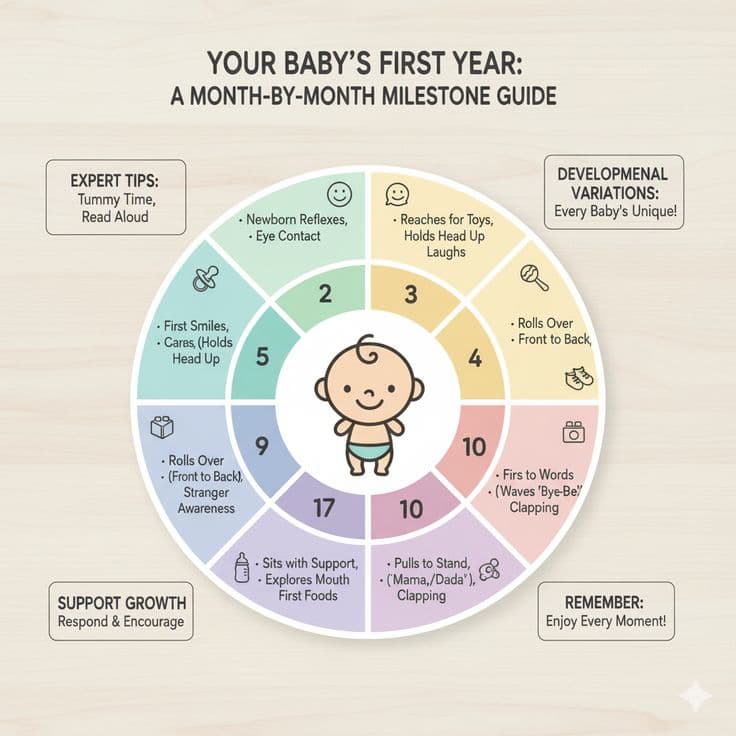
Visual Inspiration: Understanding Your Baby's First Year Development
Understanding Your Baby's First Year Development
Month 1-2: The Newborn Adaptation Period
The first two months represent a period of incredible adjustment as your baby transitions from the protected womb environment to the outside world. During this time, development focuses on basic survival and sensory integration.
Physical Development: Newborns demonstrate primitive reflexes like the Moro (startle) reflex and rooting reflex. Head control is minimal—when pulled to sit, the head lags considerably. By 2 months, babies may briefly lift their head during tummy time and show less jerky limb movements.
Visual Development: Newborns see best at 8-12 inches—perfect for studying faces during feeding. They prefer high-contrast patterns and can recognize parents' faces by 1-2 months. Smooth visual tracking emerges around 6-8 weeks.
Hearing and Communication: Babies startle at loud sounds and are soothed by familiar voices. Early cooing and gurgling begin around 6-8 weeks, and the first social smiles typically emerge during this period, representing a crucial social connection milestone.
Cognitive Development: Babies begin to recognize familiar routines and may calm when picked up or rocked. They start to understand cause and effect in simple ways, like crying leading to comfort.
Month 3-4: Emerging Social Connection and Control
This period marks a delightful shift as babies become more interactive and gain better physical control. The "fourth trimester" ends, and a more predictable routine often emerges.
Motor Skills Development: Head control improves significantly—babies can hold their head steady when supported in sitting position and push up on forearms during tummy time. Hands begin to open more, and babies discover they can bring them to their mouth intentionally.
Social-Emotional Growth: Smiles become more frequent and directed toward familiar people. Babies begin to enjoy social play and may cry when playing stops. Laughter often emerges around 3-4 months, creating joyful parent-child interactions.
Communication Advances: Cooing becomes more varied and frequent. Babies begin to make sounds in response to conversation and may imitate facial expressions. They start to distinguish between different emotional tones in voices.
Cognitive Leaps: Babies become more interested in their environment, turning toward sounds and following moving objects with their eyes. They begin to anticipate familiar routines like feeding or bathing.
Month 5-6: The Exploratory Phase Begins
Around the halfway point of the first year, babies become active explorers of their world. Physical abilities expand rapidly, and cognitive development accelerates as babies begin to understand object permanence.
Physical Milestones
Rolling Over: Most babies master rolling from front to back and back to front by 6 months, requiring increased safety measures.
Sitting Progress: With support, babies can sit steadily. Many begin to sit independently for brief periods by 6 months, though often with a protective "tripod" stance using their arms for support.
Hand-Eye Coordination: The palmar grasp reflex disappears, replaced by voluntary reaching and grabbing. Babies transfer objects between hands and explore everything with their mouth.
Cognitive and Social Advances
Object Permanence Begins: Babies start to understand that objects exist even when out of sight, leading to enjoyment of peek-a-boo games.
Vocal Development: Babbling becomes more complex with consonant-vowel combinations ("ba-ba," "da-da"). Babies respond to their own name and different emotions in voices.
Social Awareness: Stranger anxiety may begin to emerge. Babies show clear preference for familiar people and may raise arms to be picked up.
Month 7-8: Mobility and Communication Expansion
This period often brings major breakthroughs in mobility and communication. Babies become increasingly determined to move and interact with their environment in more sophisticated ways.
Mobility Milestones: Many babies begin scooting, crawling, or "combat crawling" (pulling themselves with arms). Some may start pulling to stand with support. Independent sitting becomes secure, freeing hands for play.
Fine Motor Skills: The pincer grasp (thumb and finger) begins to develop. Babies can rake small objects toward themselves and bang toys together intentionally.
Language Development: Babbling becomes more speech-like with inflection and rhythm. Babies understand "no" and other common words. Gestural communication expands with pointing, reaching, and waving.
Cognitive Advances: Problem-solving abilities grow—babies may work to retrieve a hidden toy. They understand simple cause and effect relationships and begin to imitate actions more consistently.
Month 9-10: Standing and Early Problem-Solving
As the first birthday approaches, babies become increasingly determined to stand upright and engage in more sophisticated problem-solving. This period often involves intense exploration and experimentation.
Physical Achievements: Pulling to stand becomes more confident. Many babies "cruise" along furniture. Some may stand momentarily without support. The pincer grasp becomes more refined, allowing pickup of small objects.
Communication Skills: Babies may say "mama" or "dada" specifically. They understand simple commands and respond to their name. Gestures become more varied and intentional.
Cognitive Development: Object permanence is more established—babies will search for hidden objects. They begin to use tools (like using a stick to reach something) and understand simple sequences.
Social-Emotional Growth: Stranger anxiety may peak. Babies show clear preferences for people and toys. They may test parental responses to behavior and begin to show empathy cues.
Month 11-12: Preparing for Toddlerhood
The final months of the first year prepare babies for the major transition to toddlerhood. Many are on the verge of walking and using real words, representing the culmination of a year of incredible growth.
Mobility Milestones: Many babies take their first independent steps around their first birthday, though this varies widely. Cruising becomes proficient, and sitting down from standing is mastered.
Language Explosion: Babies use a few words meaningfully and understand many more. They may follow simple one-step commands without gestures. Jabbering with speech-like inflection is common.
Cognitive Leaps: Problem-solving becomes more sophisticated—babies may try multiple approaches to a challenge. They begin to use objects correctly (brush to hair, cup to drink).
Social Development: Joint attention improves—babies look where you point and point to share interest. They may show affection to familiar people and exhibit a sense of humor.
Supporting Development Through Play and Interaction
The most powerful support for your baby's development comes through responsive interaction and appropriate play. These evidence-based strategies promote optimal development across all domains.
Responsive Caregiving: Respond promptly to cries and cues. This builds secure attachment and teaches babies that their communication is effective.
Narrate Your Day: Talk to your baby during routine activities. This exposes them to language patterns and vocabulary in meaningful contexts.
Read Together Daily: Even young babies benefit from book sharing. Point to pictures and vary your tone to maintain interest.
Provide "Floor Freedom": Give babies plenty of supervised time on the floor to practice movement skills. Create safe exploration spaces.
Offer Variated Sensory Experiences: Provide different textures, sounds, and visual experiences. Rotate toys to maintain novelty and interest.
Sing and Play Games: Simple games like peek-a-boo and patty-cake teach turn-taking and anticipation. Music supports language and emotional development.
Follow Their Lead: Join in your baby's interests rather than directing all play. This supports engagement and self-direction.
Understanding Developmental Variations: When to Celebrate Uniqueness and When to Seek Guidance
While developmental milestones provide helpful guidelines, every baby follows their own unique path. Understanding typical variations helps parents support their child's individual timeline while recognizing when additional support might be beneficial.
Normal Variations in Development
Skipping Milestones: Some babies skip crawling altogether and move directly to walking—this is typically normal.
Different Sequences: The order of skill acquisition can vary—some babies talk early and walk late, or vice versa.
Temporary Regressions: Brief returns to earlier behaviors often occur before new skill breakthroughs.
Personality Influences: Cautious babies may take longer to attempt physical milestones, while social babies might verbalize earlier.
Potential Red Flags by Age
By 3-4 Months: Doesn't follow moving objects with eyes, doesn't smile at people, doesn't bring hands to mouth
By 6-7 Months: Doesn't reach for objects, shows no affection for caregivers, doesn't respond to sounds
By 9-10 Months: Doesn't bear weight on legs with support, doesn't sit with help, doesn't babble
By 12 Months: Doesn't crawl, can't stand when supported, doesn't use gestures like waving or pointing
💡 Helpful Tips
1Create a 'yes' space where your baby can explore safely without constant 'no's—this encourages curiosity and independence.
2During tummy time, get down on the floor face-to-face with your baby to make it more engaging and enjoyable.
3Narrate your actions throughout the day—this builds language foundation even before your baby understands words.
4Respond to your baby's attempts to communicate, whether through sounds, gestures, or facial expressions—this teaches that communication is powerful.
5Provide toys that respond to your baby's actions (rattles when shaken, balls that roll) to build cause-effect understanding.
6Allow your baby to experience different textures—grass, sand, various fabrics—to support sensory development.
7Establish consistent routines—babies thrive on predictability, which supports emotional security.
8Take videos, not just photos, to capture the progression of skills and those adorable early vocalizations.
9Follow your baby's sleep cues—overtired babies have more difficulty learning and integrating new skills.
10Celebrate effort, not just achievement—clap for attempts to reach a toy, not just successful reaches.
11Provide containers of various safe household objects for exploration—wooden spoons, silicone cups, fabric scraps.
12Use a mirror at baby level—self-recognition develops gradually and provides endless fascination.
13Give your baby time to work through minor frustrations—problem-solving builds resilience and cognitive skills.
14Connect with other parents—sharing experiences normalizes developmental variations and reduces anxiety.
15Trust your instincts—you know your baby best. If something feels concerning, seek professional guidance.