
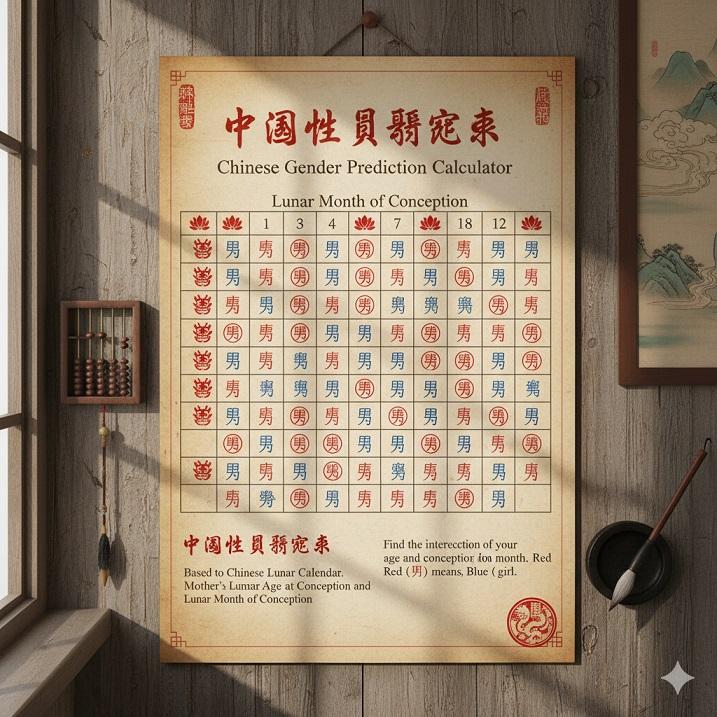
Chinese Gender Prediction Calendar 2026
Chinese Gender Predictor Calculator
Enter your age at the time of conception
Select the month when conception occurred
Understanding the Chinese Gender Prediction Calendar
The Chinese Gender Prediction Calendar, often called the Chinese Birth Chart or Chinese Conception Calendar, is an ancient tool that has fascinated expecting parents for centuries. This traditional Chinese gender predictor method claims to forecast whether you're having a boy or girl based on two simple factors: the mother's lunar age at conception and the lunar month of conception.
What makes the Chinese baby gender chart particularly intriguing is its historical significance. Believed to have been developed during the Qing Dynasty (1644-1912), the original Chinese gender prediction chart was reportedly kept in the imperial palace for exclusive royal use. The artifact was said to be discovered in a royal tomb near Beijing, though verifying these origins remains challenging for historians.
The fundamental principle behind the Chinese pregnancy calendar involves the balance of Yin and Yang energies, central concepts in traditional Chinese philosophy. According to this worldview, gender determination follows natural cycles and energy patterns that can be mapped mathematically. The Chinese gender predictor 2026 maintains these traditional calculations while making them accessible to modern users worldwide.
How to Use Our Chinese Gender Calculator 2026
Using our Chinese gender calculator is straightforward, but understanding the process can enhance your experience with this ancient prediction method.
Step 1: Determine Conception Date First, identify when conception likely occurred. If you know your due date, subtract 266 days (38 weeks) to estimate conception. For those tracking ovulation, use that date as your conception reference. The Chinese conception calendar uses the lunar month of conception, but our tool automatically handles this conversion.
Step 2: Calculate Maternal Age Enter the mother's age at the time of conception. The Chinese gender chart uses lunar age, which differs from Western age calculation. In traditional Chinese reckoning, a person is considered one year old at birth, and everyone gains a year on Lunar New Year rather than their birthday. Our Chinese gender predictor calculator automatically adjusts for these differences.
Step 3: Input Information Enter your age (18-45 years) and select the conception month from the dropdown menu. Our system will process these inputs through the traditional Chinese gender prediction algorithm.
Step 4: Receive Your Prediction The Chinese baby gender predictor will display your result instantly. The system cross-references your inputs with the ancient Chinese gender chart to determine whether you're likely having a boy or girl.
Remember that the Chinese pregnancy gender predictor is for entertainment purposes. Many users enjoy tracking the accuracy of their prediction against later ultrasound confirmation, adding an element of fun to the pregnancy journey.
Historical Accuracy of the Chinese Gender Chart
The claimed accuracy of the Chinese Gender Prediction Calendar is one of its most debated aspects. Proponents often cite historical accuracy rates of 90% or higher, particularly referencing its purported use in predicting royal births during imperial times.
However, modern scientific examination presents a more nuanced picture. Several studies have attempted to validate the Chinese gender prediction method:
- A 2010 study examining 200 births found the chart to be about 50% accurate - Anecdotal reports from online communities show wide variation in accuracy - Some users report remarkable accuracy across multiple pregnancies - Others find the Chinese baby gender predictor completely incorrect
The variability in reported accuracy may stem from several factors: - Incorrect conception date estimation - Misunderstanding of lunar age calculation - The inherent 50/50 probability of gender prediction - Confirmation bias in remembering accurate predictions
Despite mixed scientific validation, the Chinese gender calendar remains popular because it offers a tangible method for satisfying pregnancy curiosity before medical confirmation is possible. The Chinese gender predictor 2026 continues this tradition while acknowledging its limitations as a scientific tool.
Chinese Gender Prediction vs Modern Medical Methods
Understanding how the Chinese gender prediction method compares to modern medical techniques helps contextualize its role in pregnancy today.
Chinese Gender Calendar - Based on ancient traditional calculations - Uses maternal age and conception month - Immediate results at no cost - No scientific validation - For entertainment purposes only - Can be used from conception
Ultrasound Gender Determination - Medical imaging technology - Typically accurate at 18-20 weeks - Requires professional equipment and training - Scientifically validated method - 95-99% accuracy when performed correctly - Must wait until second trimester
Non-Invasive Prenatal Testing (NIPT) - Blood-based genetic testing - Can detect gender as early as 9 weeks - Over 99% accuracy for gender determination - Expensive and may not be covered by insurance - Primarily used for genetic screening - Requires medical referral
Amniocentesis/CVS - Invasive genetic testing - Near 100% accuracy for gender - Carries small risk of miscarriage - Typically reserved for high-risk pregnancies - Provides comprehensive genetic information
The Chinese baby gender chart occupies a unique space as an accessible, immediate, cost-free method that requires no medical intervention. While it shouldn't replace medical gender confirmation, many parents enjoy using the Chinese gender predictor as a complementary tradition alongside modern prenatal care.
Cultural Significance of Gender Prediction in Chinese Tradition
The Chinese Gender Prediction Calendar reflects deeper cultural values and historical contexts that extend beyond simple gender guessing.
In traditional Chinese society, gender prediction served practical family planning purposes. The preference for male heirs in imperial times made early gender knowledge valuable for succession planning. The Chinese conception calendar provided a method for anticipating family composition in cultures where sons carried on the family name and inherited property.
The philosophical foundation of the Chinese gender chart connects to broader Chinese cosmological concepts: - Yin and Yang: The balance of feminine and masculine energies - Five Elements: Wood, fire, earth, metal, water influences - Ba Gua: The eight trigrams from I Ching philosophy - Lunar Calendar: Alignment with natural celestial cycles
Modern usage of the Chinese pregnancy calendar has evolved significantly. While some families in China and abroad still incorporate gender prediction into family planning, most contemporary users approach the Chinese gender predictor as entertainment rather than serious decision-making tool.
The globalization of the Chinese baby gender predictor demonstrates how traditional practices can find new relevance in different cultural contexts. International interest in the Chinese birth chart shows universal human curiosity about unborn children's characteristics, transcending its original cultural boundaries.
Tips for Maximizing Your Chinese Gender Prediction Experience
Whether you're using the Chinese gender calculator for fun or cultural connection, these tips can enhance your experience:
1. Accurate Information Matters The precision of your Chinese gender prediction depends on accurate inputs. If possible: - Confirm conception date through ovulation tracking - Use precise maternal age at conception - Account for timezone differences if near month boundaries
2. Understand the Limitations Approach the Chinese baby gender predictor with appropriate expectations: - View results as entertainment, not medical fact - Remember the inherent 50/50 probability - Don't make important decisions based solely on the prediction
3. Combine with Other Traditions Many parents enjoy using multiple prediction methods: - Chinese gender calendar + Mayan gender chart - Old wives' tales about pregnancy symptoms - Intuition and dreams about the baby - Modern medical confirmation when available
4. Document Your Journey Tracking your Chinese gender prediction experience can be meaningful: - Record your prediction and actual result - Note any other pregnancy observations - Share the experience with partner or family - Create keepsakes of your prediction journey
5. Cultural Appreciation When using traditional methods like the Chinese conception calendar: - Respect the cultural origins - Learn about the historical context - Avoid cultural appropriation - Appreciate the method as part of human heritage
The Chinese gender predictor 2026 offers a connection to centuries of pregnancy traditions while accommodating modern users' needs. By understanding both its cultural significance and practical limitations, you can fully appreciate this unique aspect of the pregnancy experience.
Common Misconceptions About the Chinese Gender Chart
Several misconceptions surround the Chinese Gender Prediction Calendar that are worth addressing:
Myth 1: The Chart is 100% Accurate No prediction method is infallible, including the Chinese gender calendar. While some users report high accuracy, scientific studies show mixed results. The Chinese baby gender predictor should be viewed as having similar accuracy to other non-medical prediction methods.
Myth 2: It Works Better for Chinese Women There's no evidence that ethnicity affects the Chinese gender prediction results. The method uses mathematical calculations based on timing, not genetic or ethnic factors. Women of all backgrounds report varying accuracy with the Chinese pregnancy calendar.
Myth 3: You Need Special Knowledge to Use It Modern Chinese gender calculators like ours have simplified the process significantly. You don't need to understand lunar calendar conversion or Chinese age calculation - our tool handles these complexities automatically while maintaining traditional accuracy.
Myth 4: It Predicts Conception Timing for Desired Gender While some attempt to use the Chinese gender chart backwards to time conception for a specific gender, this approach has no proven effectiveness. The chart was designed as a prediction tool, not a conception planning method.
Myth 5: Medical Professionals Endorse the Method Healthcare providers generally view the Chinese gender predictor as entertainment rather than medical tool. No major medical association endorses the method for reliable gender determination.
Understanding these misconceptions helps users approach the Chinese birth chart with appropriate expectations, enhancing the experience while maintaining perspective on its limitations.
The Future of Gender Prediction Technology
As technology advances, the role of traditional methods like the Chinese Gender Prediction Calendar continues to evolve alongside modern medical capabilities.
Emerging Technologies - Early Blood Tests: Commercial gender detection tests available as early as 7 weeks - Advanced Ultrasound: Higher resolution imaging potentially allowing earlier gender identification - AI Prediction: Machine learning algorithms analyzing various pregnancy factors - Genetic Screening: Increasing accessibility and affordability of NIPT testing
Traditional Methods' Enduring Appeal Despite technological advances, traditional predictors like the Chinese gender chart maintain popularity because they offer: - Immediate results without waiting - No cost barriers to access - Cultural and historical connection - Fun, interactive experience - Privacy and personal control
Integration Approaches Many modern parents use a blended approach: - Chinese gender prediction for early curiosity - Ultrasound for mid-pregnancy confirmation - Genetic testing when medically indicated - Multiple methods for comparative entertainment
The Chinese gender predictor 2026 represents how ancient wisdom adapts to contemporary contexts. Rather than being replaced by technology, traditional methods often find new roles as complementary practices that enrich the pregnancy experience beyond pure medical functionality.
As we look forward, the Chinese baby gender chart will likely continue evolving - perhaps through mobile apps, social sharing features, or integration with other pregnancy tracking tools. However, the core appeal of connecting with centuries of human curiosity about unborn children will undoubtedly persist.
Chinese Gender Prediction Calendar - Frequently Asked Questions
How does the Chinese Gender Prediction Calendar work?
The Chinese Gender Prediction Calendar, also known as the Chinese Birth Chart or Chinese Conception Chart, predicts a baby's gender based on the mother's lunar age at conception and the lunar month when conception occurred. This ancient Chinese gender predictor tool uses a grid system that dates back over 700 years to imperial China. The chart combines the mother's age with the conception month to determine whether you're having a boy or girl according to traditional Chinese methods.
Is the Chinese Gender Prediction Chart accurate?
The accuracy of the Chinese Gender Calendar is a topic of much debate. While some studies and anecdotal evidence suggest it may be around 70-90% accurate, there's no scientific proof supporting its reliability. The Chinese pregnancy calendar is considered a fun traditional tool rather than a medically proven method. Many healthcare professionals view it as entertainment rather than a reliable baby gender predictor. For confirmed gender determination, ultrasound around 18-20 weeks or genetic testing remain the most accurate methods.
What do I need to use the Chinese gender chart calculator?
To use our Chinese gender predictor 2026 calculator, you need two pieces of information: the mother's age at the time of conception and the month when conception occurred. Our tool automatically converts these to the lunar calendar format used in the original Chinese baby gender prediction method. You don't need to calculate lunar age manually - just enter your current age and the conception month to get your Chinese gender prediction result instantly.
Does the Chinese gender chart use lunar or Gregorian dates?
Traditionally, the original Chinese gender prediction chart uses the Chinese lunar calendar for both age calculation and conception month. However, our online Chinese gender calculator automatically converts Gregorian calendar inputs to their lunar equivalents for convenience. This makes the ancient Chinese gender prediction method accessible to modern users without requiring complex lunar date calculations. The system maintains the traditional principles while simplifying the user experience.
How old is the Chinese gender prediction method?
The Chinese Gender Prediction Calendar is believed to be over 700 years old, with origins dating back to the Qing Dynasty in China. According to legend, the original chart was discovered in a royal tomb near Beijing and was used exclusively by the imperial family to predict the gender of royal heirs. The Chinese pregnancy gender predictor has been passed down through generations and remains one of the most popular traditional methods for guessing baby gender before birth.
Can I use the Chinese calendar for gender prediction in 2026?
Yes, absolutely! Our Chinese Gender Prediction Calendar 2026 is updated for current use while maintaining the traditional calculation methods. The fundamental principles of the Chinese baby gender chart remain consistent year after year. Whether you're trying to conceive in 2026 or already pregnant, our Chinese gender predictor calculator works for any conception date. The ancient Chinese gender prediction method is timeless and doesn't require annual updates to the core calculation system.
What's the difference between Chinese gender prediction and other methods?
The Chinese gender calendar differs from other prediction methods like the Mayan gender chart, Ramzi theory, or skull theory in several ways. Unlike ultrasound-based methods, the Chinese gender predictor requires no medical equipment. Compared to old wives' tales about pregnancy symptoms, the Chinese method uses specific mathematical calculations based on age and timing. The Chinese conception calendar is one of the few gender prediction tools with documented historical use spanning centuries across multiple cultures.
How do I calculate my lunar age for Chinese gender prediction?
Calculating lunar age for the Chinese gender chart can be confusing. In traditional Chinese age calculation, a person is considered one year old at birth, and everyone gains a year on Chinese New Year rather than their actual birthday. However, our Chinese gender calculator 2026 automatically handles these conversions for you. Simply enter your current age in years and the tool will make the necessary adjustments to ensure accurate Chinese gender prediction based on traditional lunar age principles.
Is the Chinese gender calendar more accurate for first pregnancies?
There's no evidence suggesting the Chinese Gender Prediction Chart works better for first pregnancies versus subsequent ones. The accuracy of the Chinese baby gender predictor appears consistent regardless of pregnancy number. However, some traditional practitioners believe that maternal factors like overall health and hormonal balance can influence results. The Chinese pregnancy calendar treats each pregnancy as independent, using the same calculation method whether it's your first baby or fifth.
Can I use Chinese gender prediction for IVF pregnancies?
Yes, you can use the Chinese gender predictor for IVF pregnancies. The calculation works the same way - you'll need the mother's age at the time of embryo transfer or conception and the month when the procedure occurred. Many couples undergoing fertility treatments enjoy using the Chinese gender chart as a fun way to guess their baby's sex before official confirmation. However, remember that the Chinese birth calendar is for entertainment and shouldn't replace medical gender determination methods.
What if my Chinese gender prediction was wrong?
If your Chinese gender prediction result doesn't match your baby's actual gender, you're not alone! The Chinese Gender Chart isn't scientifically proven and has varying accuracy rates in different studies. Many factors can affect the result, including incorrect age calculation, conception date uncertainty, or simply the inherent limitations of this traditional method. The Chinese baby gender predictor should be viewed as an entertaining cultural tradition rather than a guaranteed accurate forecasting tool.
Are there any scientific studies on Chinese gender prediction accuracy?
Several small studies have examined the accuracy of the Chinese Gender Prediction Calendar with mixed results. Some research suggests accuracy rates between 70-90%, while other studies show results no better than random chance. A 2010 study published in the 'Journal of the American Medical Association' found the chart to be about 50% accurate - essentially no better than guessing. However, many parents continue to use the Chinese gender calculator for fun while acknowledging its limitations as a scientific tool.
Can I use Chinese gender prediction for twins or multiples?
The traditional Chinese Gender Prediction Chart was designed for single births, so its application to twin pregnancies is uncertain. Some practitioners suggest using the chart for each baby individually, while others believe it may predict the gender of the dominant twin. For triplets or higher-order multiples, the Chinese baby gender predictor becomes even less reliable. If you're expecting multiples, consider the Chinese gender calendar results as purely speculative entertainment rather than accurate predictions.
How popular is the Chinese gender chart today?
The Chinese Gender Prediction Calendar remains extremely popular worldwide, with millions of users each year. Despite the availability of modern medical technology, many expecting parents enjoy using the Chinese gender predictor as a fun tradition. Online searches for 'Chinese gender calendar,' 'Chinese gender predictor 2026,' and 'Chinese birth chart' consistently rank among the top pregnancy-related queries. The method's enduring popularity speaks to its cultural significance and the universal curiosity about baby gender during pregnancy.
Are there any cultural considerations when using the Chinese gender chart?
When using the Chinese Gender Prediction Calendar, it's important to understand its cultural context. In traditional Chinese culture, the chart was historically used for family planning and gender preference, though modern usage is primarily for entertainment. Some families still incorporate the Chinese gender predictor into pregnancy traditions alongside other customs like gender reveal parties. Regardless of cultural background, users should approach the Chinese baby gender chart as a fun activity rather than a serious planning tool.
ADVERTISEMENT
Quick Facts
- • Used for over 700 years
- • Based on lunar calendar calculations
- • Traditional Chinese method
- • Fun entertainment tool
- • No scientific guarantee